Most Common Chinese Characters List
Most Common Chinese Characters List
Learning a new language is always daunting. With so much vocabulary to take on board, so many idioms to get to grips with, and a whole world of new meaning to delve into, it is easy to see why so many people feel overwhelmed at the prospect.
When it comes to learning Chinese, this feeling is heightened. While the average American will be able to read a word in French or German and have a pretty good shot at pronouncing or even understanding it, the same cannot be said for reading Chinese words. Chinese writing, after all, is far removed from the Latin alphabet that many learners are used to.
Getting to Grips with Chinese Writing
So how do we overcome this anxiety? Well, we can begin by taking a look at a handy Chinese character list which will provide an understanding of some of the most common Chinese characters you are likely to encounter. This list will also include the pinyin for each character, which is the representation of Chinese characters in the Latin alphabet. For example, 北京 becomes Běi Jīng, or Beijing, in pinyin.
Getting to grips with these characters will be an important step on the road to learning and becoming proficient in Chinese. These are characters that you will see every single day on an internship or gap year program in China, and which will act as your entry point to Chinese writing. With this base level of understanding established, you’ll be able to reach ever higher and further, into this fascinating and ancient language.
How Do We Know Which Characters are the Most Common?
Of course, there are many Chinese characters – more than 2400 basic characters, and over 5000 characters in total — and the average Chinese speaker will use hundreds of characters each day. So, how can we tell which ones are the most common?
For this list, we will be using Jun Da’s Modern Chinese Character Frequency Guide — a fascinating look at the usage levels and patterns of almost all characters in the Chinese language. We won’t be delving too far into this just yet. Instead, we’ll be giving you a basic rundown of how to recognize some of the most common Chinese characters out there.
Let’s begin!
Common Chinese Characters
Before we dive headlong into the Chinese character list, let’s first take a look at some basic sentence structure using some of the most common Chinese characters. This will help you not only to recognize the character you are reading as you learn Chinese in China or at home but also to begin to use the characters you learn in the right context as you learn more and more Chinese words.
The Chinese Character for Love
The Chinese character for love is 爱, pronounced ài, using the descending fourth tone. This tone is not, however, exactly the same as a descending fourth interval in Western music: two separate notes a fourth apart.
In the Chinese system, the pitch drops within the tone itself — much like a portamento in Western music. You can learn more about Chinese tonal pronunciation on Chinese Pod’s helpful article, “Tones.”
You might want to use ai in the sentence “I love you.” This is constructed in much the same way as the English version;
我 – wǒ (pronounced using the dipping third tone) – “I” in English.
爱 – ài (fourth tone) – “Love” in English
你 – nǐ (pronounced using the same third tone as wǒ) – “You” in English.
我爱你 – wǒ ài nǐ – I love you.
The Chinese Symbol for Family
The Chinese symbol for family, or home, is 家, pronounced jiā using the flat second tone.
When used on its own, 家 refers to one’s home. When referring to family, it is commonly combined with other characters. For example;
家庭 – jiā tíng (ting is pronounced using the rising first tone) – In English, this means family or household
家人 – jiā rén (like ting, ren is pronounced using the rising first tone) – Ren is the Chinese word for people, so jia ren refers to family members.
I Miss You in Chinese
The sentence “I miss you” in Chinese is constructed in much the same way as “I love you,” however, ài is substituted for xiǎng, “to miss [someone or something].”
The character for “miss” in Chinese is 想, xiǎng, pronounced with the dipping third tone.
我想你 – wǒ xiǎng nǐ – I miss you
I Like You in Chinese
As you might expect, the Chinese sentence for “I like you” is constructed in the same way as the sentences for “I love you” and “miss you.” However, there is one subtle difference, and this lies in the Chinese word for “like.”
The Chinese word for like is 喜欢, which is as you can see is made up of two characters rather than only one. This is pronounced xǐ huān, using the dipping third tone for the xǐ and the flat second tone for the huān.
Adding the “I” and “you” gives us;
我喜欢你 – wǒ xǐ huān nǐ – I like you
The Hardest Chinese Character
It is not unusual to find it difficult to write and read Chinese characters, particularly if your native language utilizes an alphabet rather than a character system. It is also likely that you will find some characters easier to write and to recognize than others.
For example, the Chinese characters 人 — rén, meaning “people,” and 大 – dà meaning “big” — are straightforward characters which are easy to spot. Even a character like 太 – tài, meaning “too,” as in “this is too hot” — which looks very similar to 大, dà, but includes an extra stroke — will not be too difficult to recognize after some practice.
Difficulties with Similar Chinese Words
Similarities between characters can cause difficulties when the characters in questions are a little more complex. For example, the character 昆 – kun, as in the city, Kunming — looks similar at first glance to the character 民 – mín, meaning “people,” as in 人民广场, rén mín guǎng chǎng, or People’s Square. This is where recognizing the context of the word can be very helpful when you are beginning to learn Chinese characters.
However, some characters are difficult to learn because they are so complex. A Chinese character is made up of strokes. For example, a simple character such as 人 requires only two strokes on the paper, while a more complex character like 南 – nán, meaning “south” — will require nine strokes.
When Chinese Writing Gets Complex
And it can get much more complex than this! The Chinese word biáng, used to describe the popular Shǎnxī province noodle dish, biáng biáng mian requires an astonishing 57 strokes. Take a look at this one below.
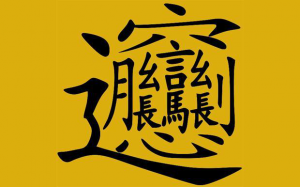
Modern Chinese writing is far simpler than traditional Chinese, and so many of the more extreme characters are no longer used in everyday life. For example, the character zhé, meaning “verbose,” required 64 strokes. Students interested in learning Chinese in Beijing, Shanghai, Nanjing, or elsewhere will probably breathe a sigh of relief when they discover it is now obsolete.
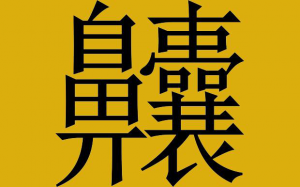
Just because modern Chinese is simplified, however, doesn’t mean there are not still tricky characters to tackle. Take a look at nàng, a word used to describe the muffled sound of a voice when you have a cold or a blocked up nose. This one requires 36 strokes on the page.
A List of the Most Common Chinese Characters
Now that we have a better understanding of Chinese characters and their usage, let’s take a look at the most common Chinese characters list, along with pinyin representations, English definitions, and a few helpful examples.
| Jun Da ranking | Chinese character | Pinyin | English definition |
| 1 | 的 | de | There is no direct translation of de in English, but the character is used to show ownership or to attribute an adjective. For example: 这是我的钢笔 – zhè shì wǒ de gāng bi – This is my pen. 钢笔是蓝色的 – gāng bǐ shì lán sè de – The pen is blue. |
| 2. | 一 | yí | “One,” “a,” or “single.” Often used in conjunction with a quantity word such as 个, gè. For example; 一个人 – yí gè rén – One person. 这是一样的 – zhè shì yí yàng de – This is the same. |
| 3. | 了 | le | Again, there is no direct translation of le in English, but the character refers to something in the past or something which is ongoing. Sometimes it is used as an exclamation. For example; 你吃饭了吗 – nǐ chī fàn le ma – Have you eaten? 太神奇了 – tài shén qí le – So [too] amazing! |
| 4. | 是 | shì | Roughly translated as “yes” or “is.” For example; 是不是 – shì bù shi – Yes or no? (A common question in Chinese conversation, sometimes used in a similar way to “right?” or “you know what I mean?” in English.) 这是正确的 – zhè shì zhèng què de – This is correct. |
| 5. | 我 | wǒ | “I” or “me.” For example; 这是我的包吗 – zhè shì wǒ de bāo ma – Is this my bag? |
| 6. | 不 | bù | Roughly, “no” or “not,” or to signify a negative. For example; 我不开心 – wǒ bù kāi xīn – I am not happy. 不需要 – bù xū yào – Unnecessary / not needed |
| 7. | 在 | zài | Usually “at,” but also used to demonstrate an action in the present. For example; 我在家 – wǒ zài jiā – I am at home. 我在吃饭 – wǒ zài chī fàn – I am eating. |
| 8. | 人 | rén | “Person.” For example; 他是个聪明的人 – tā shì gè cōng míng de rén – He is an intelligent person. 他们是德国人 – tā men shì dé guó rén – They are German [people]. |
| 9. | 们 | men | Usually used to demonstrate a plural when talking about people. 我们– wǒ men – Us / We. 这是他们的 – zhè shì tā men de – It is theirs. |
| 10. | 有 | yǒu | “Have.” For example; 我有一顶新帽子 – wǒ yǒu yī dǐng xīn mào zi – I have a new hat. 有没有[…] – yǒu méi yǒu […] – Have, not have [something]? (A common way to ask for something in Chinese, for example, in a shop or restaurant). |
Now that you have got to grips with these ten most common Chinese characters, you can start to add more to your repertoire. Below are more of the most common characters you are likely to experience every day on an internship in China.
| 他 | tā | he/him |
| 这 | zhè | this |
| 中 | zhōng | middle/medium/central |
| 大 | dà | big |
| 来 | lái | come |
| 上 | shàng | above, on, over, up, last, previous |
| 国 | guó | country, nation, can also be a name |
| 个 | gè | A non-specific counting word for a noun, usually preceded by a number |
| 到 | dào | to, towards, until, arrive, reach |
| 说 | shuō | Say/speak. Also, explain or refer to |
| 们 | men | Pluralizer for nouns related to people. For example, 我们 – wǒmen – we |
| 为 | wèi | for/ in order to |
| 子 | zǐ | child/son. Also used as a suffix on some nouns, particularly small animals and objects |
| 和 | hé | together/with |
| 你 | nǐ | you (male). Female: 妳 – nǐ |
| 地 | dì | earth/soil, place/position |
| 出 | chū | go out, come out, exit |
| 道 | dào | way, path, channel, a streak (of light), the Taoist religion |
| 也 | yě | also |
| 时 | shí | period, season |
| 年 | nián | year |
| 得 | de | Particle connecting a verb to its adverb |
| 就 | jiù | just, right away |
| 那 | nà | that |
| 要 | yào | want, will |
| 下 | xià | below, under, down, next (relating to time) |
| 以 | yǐ | use, take, according to, because of, in order to |
| 生 | shēng | give birth, life |
| 会 | huì | can, able, meet, meeting, society, union, party |
| 自 | zì | from, since |
| 着 | zhe | particle showing that the verb’s effect is continuous |
| 去 | qù | go, leave |
| 之 | zhī | Demonstrates ownership, similar to 的 de |
| 过 | guò | pass, exceed, also a verb particle to show that an event has happened before or that the speaker has experienced this before |
| 家 | jiā | home, house, family |
| 学 | xué | study |
| 对 | duì | To indicate that something is correct or agreed with |
| 可 | kě | To indicate possibility or potential , 可以 – kěyǐ -may, can |
| 她 | tā | she, her |
| 里 | lǐ | neighborhood, half-kilometer, Also a common family name |
| 后 | hòu | queen |
| 小 | xiǎo | small |
| 么 | me/mo | Suffix used to create a direct question. 什么? – shénme? – What? |
| 心 | xīn | heart |
| 多 | duō | many, much, more |
| 天 | tiān | sky, heaven, day |
| 而 | ér | furthermore |
| 能 | néng | can, be able |
| 好 | hǎo | Signifying that something is good, acceptable, or agreed upon |
| 都 | dōu | all, both |
| 然 | rán | That’s correct, so, next |
| 没 | méi | haven’t, have none, there isn’t |
| 日 | rì | sun |
| 于 | yú | in, at, for, to, from, by, than |
| 起 | qǐ | rise, start |
| 还 | hái | still, yet |
| 发 | fā | deliver, grow, utter |
| 成 | chéng | become, also a family name |
| 事 | shì | matter, event, accident, job, responsibility |
| 只 | zhǐ | only, just, barely |
| 作 | zuò | do, make |
| 当 | dāng | serve as, for the purpose of |
| 想 | xiǎng | think, consider, want |
| 看 | kàn | see, watch, look at, read, think, consider |
| 文 | wén | language, literature |
| 无 | wú | without something, nothingness, have not |
| 开 | kāi | open |
| 手 | shǒu | hand, Someone with a skill |
| 十 | shí | ten |
| 用 | yòng | use |
| 主 | zhǔ | lord, host, god, |
| 行 | xíng | go, Permitted |
| 方 | fāng | side, square |
| 又 | yòu | again, both, and |
| 如 | rú | like, as, as if |
| 前 | qián | in front, forward, previous, ago, former |
| 所 | suǒ | place |
| 本 | běn | basis, edition, also a classifier word for books |
| 见 | jiàn | appearance, to meet with |
| 经 | jīng | Constant, regular, deal with, also a family name, among many other uses |
| 头 | tóu | head |
| 面 | miàn | surface or face, also a classifier for flags and mirrors |
| 公 | gōng | public, shared, official |
| 同 | tóng | same, with |
| 三 | sān | three |
| 已 | yǐ | stop, end |
| 老 | lǎo | old, term of respect, outdated |
| 从 | cóng | from, through, join |
| 动 | dòng | move, change |
| 两 | liǎng | two of |
| 长 | cháng | long, length |
4
So, by now you’ve not only made the first steps on your journey to proficiency with Chinese writing and reading – you’ve made giant leaps toward your goal. What comes next? Well, as with any language learning process, you need to keep practicing and keep adding to your vocabulary.
Here at Go Abroad China, we can help you. Browse our articles online for more support and resources designed to make your learning journey easier, or get in touch with our team to find out more.